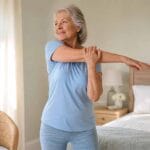


Best Balance Exercises for Seniors Over 65 to Prevent Falls at Home (2026 Guide)
A fall that takes seconds can change everything. For a senior, a stumble in the kitchen, a misstep on the porch, or a slip getting out of the bathtub can result in a broken hip, a hospital stay, a loss of independence — and in far too many cases, a dramatic decline in overall health from which recovery is never complete.
Falls are not an inevitable part of aging. They are largely preventable. And the most powerful prevention tool available is not a grab bar, a non-slip mat, or a medical alert device — though all of those help. The most powerful intervention is a regular, targeted balance and strength exercise program.
This guide was written for American seniors over 65, their family caregivers, and the adult children who want to help their parents stay safe, strong, and independent for as long as possible. Inside, you’ll find 12 step-by-step balance exercises designed specifically for home use — no gym, no expensive equipment, no special training required. Each exercise includes an easier modification for those just beginning, and every safety principle you need to practice confidently.
The exercises in this guide are grounded in evidence from the CDC’s STEADI (Stopping Elderly Accidents, Deaths & Injuries) initiative, the Cochrane Collaboration’s landmark fall prevention reviews, and guidelines from the American Geriatrics Society and the American Physical Therapy Association. This is not generic fitness content — it is clinically informed, age-specific, and designed to keep you or your loved one safe.
| 📌 Who This Guide Is For: This guide is appropriate for adults 65 and older who are ambulatory (able to walk independently or with a cane or walker), not currently recovering from a recent fall-related injury, and cleared by a physician for light exercise. If you are recovering from a fall, fracture, or surgery, please work with a physical therapist before beginning. |
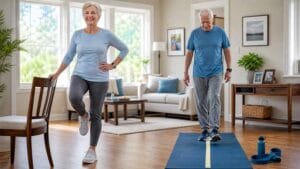
Why Balance Training Is a Life-or-Death Priority for American Seniors
The fall statistics in the United States are not simply concerning — they are a public health emergency. The Centers for Disease Control and Prevention (CDC) has made fall prevention one of its top priorities for older American adults, and the evidence for why is stark.
| The Problem: Fall Statistics in the USA | The Solution: What Exercise Can Do |
| • 1 in 4 Americans over 65 falls each year • Falls are the #1 cause of injury death in seniors (CDC) • 3 million seniors treated in ER for falls annually • Hip fractures: 300,000+ per year — 20–30% die within a year • Falls cost the U.S. healthcare system $50 billion per year • Fear of falling causes 50%+ of seniors to reduce activity — worsening balance | • Regular balance training reduces fall risk by 23–37% (Cochrane Review) • Tai Chi reduces falls in seniors by up to 55% (NEJM study) • Strength + balance combo training = strongest evidence base • Just 2–3 sessions per week produce clinically significant results • Home-based programs are as effective as clinic-based programs for most seniors • Exercise also reduces fall-related injury severity when falls do occur |
The most important insight in that table: fear of falling causes many seniors to move less, which weakens muscles and balance further — creating a dangerous downward spiral. The solution is not caution and stillness. The solution is targeted, safe movement that rebuilds the physical systems that prevent falls in the first place.
Why Balance Declines After 65 — And What You Can Do About It
Balance is not a single physical ability — it is a complex neurological and muscular system involving three separate inputs that the brain constantly integrates to keep you upright:
- Vision: The eyes provide spatial orientation cues. With age, vision deteriorates, reducing the brain’s ability to use visual anchoring for balance — particularly in low-light environments.
- Vestibular system: The inner ear’s fluid-filled canals detect head movement and position. Age-related changes in the vestibular system slow response time and reduce sensitivity to postural shifts.
- Proprioception: Sensory receptors in the muscles, joints, and skin constantly feed information about body position to the brain. Proprioceptive sensitivity declines significantly with age — meaning the brain receives slower, less accurate signals about where the feet and limbs are in space.
Beyond these three sensory systems, falls are driven by muscular weakness — particularly in the ankles, hips, and core — and reduced reaction time. When a foot catches on a rug or the body unexpectedly shifts weight, the muscular and neurological response that would normally prevent a fall becomes too slow or too weak to compensate.
The extraordinary good news: all of these systems respond to exercise. The vestibular system can be retrained. Proprioception improves with targeted standing and balance challenges. Ankle and hip strength respond rapidly to resistance training. And reaction time, while it does decline with age, can be slowed and partially reversed through regular physical activity.
| The Science: A landmark Cochrane Review analyzing 159 randomized controlled trials and 79,193 older adults found that exercise reduces the rate of falls in community-dwelling older adults by 23%, and reduces the number of people who experience falls by 15%. Exercise combining balance and strength training showed the strongest effects — the exact combination in this guide. |
Safety Setup: Before You Begin Any Balance Exercise
Safety preparation is not optional — it is the foundation of an effective fall prevention program. Before performing any exercise in this guide, complete the following safety setup every single session.
Your Safe Exercise Environment Checklist
- Clear the floor area of rugs, cords, shoes, or any loose objects within a 6-foot radius
- Position a sturdy, non-wheeled chair (dining chair or kitchen chair with armrests) directly beside you — this is your safety anchor for every exercise
- Exercise on a firm, non-slip surface — carpet, rubber mat, or non-slip flooring; avoid polished hardwood or tile without a mat
- Wear supportive, non-slip footwear with a flat or low heel — never exercise barefoot on a smooth floor or in socks only
- Ensure adequate lighting — dim lighting is a significant fall risk during exercise
- Keep a phone within reach at all times
- Never exercise immediately after taking sedating medications (sleep aids, certain blood pressure drugs, antihistamines)
- If you use a walking aid (cane or walker), keep it within one step at all times — do not exercise beyond its reach unless specifically instructed by a physical therapist
| Stop Exercising Immediately If: you experience dizziness, sudden chest pain, shortness of breath, unusual palpitations, severe joint pain, or a sudden feeling that you may fall. Sit down slowly using your safety chair, rest, and contact your healthcare provider if symptoms persist. These are not normal exercise sensations. |
The 12 Best Balance Exercises for Seniors at Home
These 12 exercises are organized from foundational (Beginner Level 1) through progressive (Level 2) to challenge exercises (Level 3). Begin at Level 1 and only advance when you can complete Level 1 exercises comfortably and consistently for 2 weeks without loss of balance.
| 🪑 Your Chair Rule: Keep one hand lightly resting on the back of your safety chair for all Level 1 exercises. As you progress to Level 2, aim to use only fingertip contact. Level 3 exercises are performed without chair support — only attempt these when you are fully stable at Level 2. |
LEVEL 1 — Foundation Exercises (Weeks 1–2)
| Exercise 1: Weight Shifting Side to Side Level 1 — Beginner | |
| 🎯 Targets: Ankles, hips, core stabilizers 🔁 Reps / Duration: 10 repetitions, 2 sets | 📋 How to perform: • Stand beside your chair, feet hip-width apart, both hands resting lightly on the back • Slowly shift your weight entirely onto your right foot, lifting the left heel slightly off the floor • Hold for 3 seconds, then slowly shift weight back to the center • Repeat on the left side — this is one repetition • Move slowly and with full control; the goal is controlled weight transfer, not speed 💡 Easier version: Keep both feet flat on the floor throughout; simply feel the weight shift without lifting the heel |
| Exercise 2: Heel-to-Toe Standing (Tandem Stand) Level 1 — Beginner | |
| 🎯 Targets: Ankle stabilizers, postural muscles, vestibular system 🔁 Reps / Duration: Hold 10–30 seconds, 3 repetitions each side | 📋 How to perform: • Stand beside your chair, one hand resting on the back for support • Place your right foot directly in front of your left so that the right heel touches the left toes • Straighten up and hold this narrow tandem position with both feet on the floor • Focus your gaze on a fixed point at eye level — this is your visual anchor • Hold for 10 seconds to start; work toward 30 seconds over 2 weeks • Switch foot positions and repeat 💡 Easier version: Stand with feet close together (not tandem) and hold the chair with both hands |
| Exercise 3: Sit-to-Stand Without Using Hands Level 1 — Beginner / Functional | |
| 🎯 Targets: Quadriceps, glutes, core, ankle dorsiflexors 🔁 Reps / Duration: 10 repetitions, 2–3 sets | 📋 How to perform: • Sit at the front edge of a firm chair, feet hip-width apart, flat on the floor • Lean forward slightly from the hips — bring your nose over your toes • Push through both feet evenly and stand up slowly without using your hands • Stand tall, pause for 2 seconds, then slowly lower back to sitting — do not drop down • The lowering phase is as important as standing — it builds eccentric leg strength 💡 Easier version: Use one hand on the armrest for assistance; gradually reduce hand support over weeks |
| Exercise 4: Heel Raises (Calf Strengthening) Level 1 — Beginner | |
| 🎯 Targets: Gastrocnemius, soleus (calves), ankle stabilizers 🔁 Reps / Duration: 15 repetitions, 2–3 sets | 📋 How to perform: • Stand behind your chair, holding the back lightly with both hands • Place feet hip-width apart, toes pointing forward • Slowly raise both heels off the floor, rising onto your tiptoes • Hold at the top for 2 seconds — do not rush this phase • Slowly lower heels back to the floor in a controlled 3-count • Focus on the ‘squeeze’ in your calf muscles at the top 💡 Easier version: Perform seated heel raises: sit in a chair and raise only the heels while seated to build initial calf strength |
LEVEL 2 — Progressive Exercises (Weeks 3–4)
| Exercise 5: Single Leg Stand Level 2 — Intermediate | |
| 🎯 Targets: Hip abductors, ankle stabilizers, proprioceptive system 🔁 Reps / Duration: Hold 10–30 seconds, 3 repetitions each leg | 📋 How to perform: • Stand beside your chair, fingertips resting lightly on the back • Slowly lift your right foot a few inches off the floor, bending the knee gently • Hold the position with your weight balanced entirely on the left foot • Keep your standing knee slightly bent (not locked); stand tall, eyes forward • Work up from 10 seconds to 30 seconds over 2–3 weeks • Switch legs. Aim for equal stability on both sides 💡 Easier version: Begin by lifting just the heel (toes remain on floor) to reduce balance demand |
| Exercise 6: Heel-to-Toe Walking (Tandem Walk) Level 2 — Intermediate | |
| 🎯 Targets: Full lower body, vestibular system, gait mechanics 🔁 Reps / Duration: 10 steps forward, 10 steps back, 2 sets | 📋 How to perform: • Position your chair to the side — available to grasp if needed • Start at one end of a clear hallway or room • Place your right heel directly in front of your left toes to begin • Walk forward in this heel-to-toe line for 10 steps • Focus on a fixed point ahead — do not look down at your feet • Turn carefully and return heel-to-toe for 10 steps • Touch the wall or chair only if needed for balance correction 💡 Easier version: Walk with feet in a narrower-than-normal line (not strictly tandem) until tandem walking is comfortable |
| Exercise 7: Standing Marching in Place Level 2 — Intermediate | |
| 🎯 Targets: Hip flexors, core, balance and coordination 🔁 Reps / Duration: 20 repetitions (10 each leg), 2–3 sets | 📋 How to perform: • Stand behind your chair, fingertips lightly on the back • Slowly lift your right knee toward hip height (or as high as comfortable) • Hold for 2 seconds at the top, then slowly lower • Alternate legs with each repetition • Maintain an upright posture throughout — do not lean forward as the knee lifts • Progress by adding light ankle weights (1 lb) after 2 weeks of comfortable practice 💡 Easier version: Lift knee to lower height (45 degrees); shorten the hold time to 1 second |
| Exercise 8: Side Leg Raises (Hip Abduction) Level 2 — Intermediate | |
| 🎯 Targets: Hip abductors (gluteus medius), IT band, lateral stabilizers 🔁 Reps / Duration: 12 repetitions each side, 2–3 sets | 📋 How to perform: • Stand beside your chair, holding the back with your right hand • Keeping both legs straight, slowly lift your left leg out to the side — approximately 12–18 inches • Hold for 2 seconds at the top, then lower slowly in a 3-count • Keep your torso upright — do not lean to the right as the left leg rises • Complete all repetitions on one side before switching • The gluteus medius targeted here is one of the most important fall-prevention muscles 💡 Easier version: Reduce range of motion (6-inch lift); hold chair with both hands |
| Exercise 9: Backward Leg Raises (Hip Extension) Level 2 — Intermediate | |
| 🎯 Targets: Glutes (gluteus maximus), hamstrings, lower back extensors 🔁 Reps / Duration: 12 repetitions each side, 2–3 sets | 📋 How to perform: • Stand behind your chair, holding the back with both hands • Keeping the right leg straight, slowly lift it directly backward — approximately 6–10 inches • Do not arch the lower back or tilt the pelvis forward as the leg rises • Hold for 2 seconds at the top, lower slowly • The movement should come from the hip joint, not the lower back • Complete all reps on one side before switching 💡 Easier version: Reduce range to 3–4 inches of backward lift; focus on slow, controlled movement |
LEVEL 3 — Challenge Exercises (Weeks 5–6 and Beyond)
| ⚠️ Level 3 Safety Note: Only attempt Level 3 exercises after 4+ weeks of consistent Level 1 and Level 2 practice, and only with your safety chair within one arm’s reach. If at any point you feel unsteady, grasp the chair immediately. Never rush this progression. |
| Exercise 10: Single Leg Stand — Eyes Closed Level 3 — Challenge | |
| 🎯 Targets: Full balance system, vestibular dominance, proprioception 🔁 Reps / Duration: Hold 5–20 seconds, 3 repetitions each leg | 📋 How to perform: • Stand beside your chair with fingertips available but not touching • Lift one foot and stabilize your single-leg stance with eyes open (5 seconds) • Gently close your eyes and continue holding the position • This dramatically increases balance challenge — removing visual anchoring forces the vestibular and proprioceptive systems to work harder • Start with 5 seconds eyes-closed; work toward 20 seconds over several weeks • Open eyes immediately if feeling unstable; grasp the chair if needed 💡 Easier version: Perform with eyes open but gaze downward (removes the visual horizon reference without full eye closure |
| Exercise 11: Clock Reach Exercise Level 3 — Challenge | |
| 🎯 Targets: Hip stabilizers, ankle dorsiflexors, dynamic balance, reach stability 🔁 Reps / Duration: 3 repetitions each leg, in each clock direction | 📋 How to perform: • Imagine a clock face on the floor around your standing foot • Stand on your right leg, arms relaxed • Reach your left foot slowly to 12 o’clock (directly forward) without touching the floor • Return to center, then reach to 3 o’clock (directly to the left) • Return to center, then reach to 6 o’clock (directly behind) • Complete all three directions for one repetition • Switch legs and repeat — left leg standing, right foot reaching • Progress by increasing reach distance or adding 9 o’clock direction 💡 Easier version: Perform with a light fingertip touch on the chair for support; reduce reach distance to half |
| Exercise 12: Tandem Stance with Head Turns Level 3 — Challenge | |
| 🎯 Targets: Vestibular system, cervical proprioception, dynamic postural control 🔁 Reps / Duration: 5 slow turns each direction, 3 repetitions | 📋 How to perform: • Position yourself in a tandem stance (heel-to-toe), chair available beside you • Once stable, slowly turn your head to the right — look over your right shoulder • Return head to center, pause 2 seconds • Slowly turn your head to the left — look over your left shoulder • Return to center — this is one repetition • Head turning challenges the vestibular system because it separates head position from body position, a common cause of real-world falls • Progress to up-and-down head nods once lateral turns are comfortable 💡 Easier version: Perform head turns while standing in regular stance (feet hip-width) before progressing to tandem stance |
The Gold-Standard Fall Prevention Practice for Seniors
No guide on fall prevention for seniors would be complete without a dedicated discussion of Tai Chi. Among all interventions studied for fall prevention in older adults, Tai Chi has the strongest and most consistent evidence base, reducing falls by up to 55% in some trials, according to a landmark study published in the New England Journal of Medicine.
Tai Chi is a centuries-old Chinese movement practice that combines slow, flowing weight shifts, controlled arm movements, and mindful breathing. From a Western biomechanical perspective, it simultaneously trains ankle stability, hip strength, vestibular function, reaction time, and postural awareness — the exact systems that prevent falls. It is also low-impact, gentle on joints, and accessible to most seniors regardless of fitness level.
In 2026, Tai Chi classes will be widely available across the United States in formats accessible to seniors:
- In-person classes at senior centers, YMCAs, community recreation centers, and physical therapy clinics (often covered by Medicare Advantage plans as a fall-prevention benefit)
- Online via YouTube channels like Tai Chi Health (Scott Cole), Tony Wong Tai Chi, and Yoqi Yoga and Qi Gong — all free
- Evidence-based programs: Tai Chi Moving for Better Balance (TCMBB) and the Otago Exercise Programme have been specifically validated in clinical trials and are recommended by the CDC’s STEADI program
The minimal effective dose appears to be 2–3 sessions per week of at least 30–45 minutes each, maintained for at least 12 weeks. Benefits compound with continued practice over months and years.
Recommended Weekly Balance Training Schedule
The following weekly schedule combines the exercises in this guide into a sustainable, progressive routine. This plan is designed for 3 active days per week with rest and gentle movement on alternate days — consistent with guidelines from the American Geriatrics Society for older adult fall prevention programming.
| Monday | Tuesday | Wednesday | Thursday | Friday | Saturday | Sunday |
| Balance Routine A (15–20 min) Morning preferred | Gentle Walk 20–30 min + Stretching | Balance Routine B (15–20 min) + Chair Yoga | Rest or Light Walk 15 min | Balance Routine A (15–20 min) + Core Work | Tai Chi or Yoga Class (optional) | Complete Rest & Recovery |
| 🕐 Best Time to Exercise: Morning exercise (before noon) is associated with better balance performance in most older adults — cortisol levels are naturally higher in the morning, which supports alertness and coordination. Avoid exercising when fatigued, immediately after a large meal, or within 2 hours of taking sedating medications. |
Home Safety Modifications That Complement Your Exercise Program
Exercise is the most powerful fall prevention intervention — but home safety modifications provide a critical second layer of protection. The CDC estimates that over half of all senior falls occur inside the home, most commonly in the bathroom, bedroom, and on stairs.
Bathroom (Highest Risk Area)
- Install grab bars beside the toilet and inside the shower or bathtub — use professional installation with wall-stud anchoring (not suction cups for primary bars)
- Use a non-slip bath mat inside the tub and a non-slip floor mat outside
- Consider a shower chair or tub transfer bench if standing balance is compromised
- A handheld showerhead allows bathing while seated
Throughout the Home
- Remove all throw rugs or secure them with non-slip backing and double-sided tape
- Ensure all stairways have solid, graspable railings on both sides
- Improve lighting — especially at night. Nightlights in hallways, bathrooms, and bedrooms are among the single highest-value fall prevention investments
- Keep frequently used items within easy reach — avoid step stools or climbing
- Secure or remove all electrical cords from walkways
- Wear supportive, well-fitting shoes indoors — never walk in socks on smooth floors
Technology Aids in 2026
Medical alert devices (Life Alert, Apple Watch Fall Detection, Amazon Halo Rise) have become significantly more sophisticated by 2026. Wearable fall detection devices can automatically call emergency services when a fall is detected — an important safety net for seniors who live alone. Many Medicare Advantage plans now cover approved fall detection wearables as a preventive benefit.
Medications and Fall Risk: What Every Senior Should Know
Medications are the most underestimated fall risk factor in American seniors. The CDC identifies polypharmacy (taking 4 or more medications) as a major independent risk factor for falls. Specific medication classes are particularly concerning:
- Sedatives, sleep aids, and anti-anxiety medications (benzodiazepines like Xanax, Valium, Ativan) — cause drowsiness, slow reaction time, and impair balance
- Blood pressure medications — can cause orthostatic hypotension (a sudden drop in blood pressure when standing), the most common medication-related fall trigger
- Diuretics (‘water pills’) — contribute to dehydration, which impairs blood pressure regulation and cognitive function
- Muscle relaxants, certain antidepressants, and antipsychotics — all associated with increased fall risk
- First-generation antihistamines (Benadryl/diphenhydramine) — commonly used as sleep aids; cause significant drowsiness and balance impairment in older adults
The American Geriatrics Society’s Beers Criteria is the definitive list of medications that are potentially inappropriate for older adults — and it is updated regularly. Ask your physician to conduct an annual medication review with fall risk in mind, particularly if you have experienced a recent fall or near-fall. Deprescribing (safely reducing or eliminating unnecessary medications) is an increasingly recognized and practiced approach to fall prevention in geriatric medicine.
Frequently Asked Questions
Q: How quickly will I see improvements in my balance? Most seniors notice meaningful balance improvements within 4–6 weeks of consistent practice (3 sessions per week). Proprioceptive adaptations occur relatively quickly — within 2–4 weeks. Strength gains in ankles and hips, which support these improvements, develop over 6–8 weeks. The important thing is to start — even modest improvements in balance translate to significant real-world fall risk reduction.
Q: What if I have already had a fall? A previous fall is one of the strongest predictors of future falls, which makes it even more important to begin a balance program. However, if you have had a fall in the last 6 months, we strongly recommend starting with a physical therapist evaluation before beginning independently. Many Medicare plans cover physical therapy for fall prevention without a referral.
Q: Can I do these exercises if I use a walker or a cane? Yes, with modification. A walker or cane is a safety tool, not a reason to avoid exercise. Most Level 1 and Level 2 exercises can be performed using your walker in place of the chair. Level 3 exercises should only be attempted under the supervision of a physical therapist if you regularly use a walking aid.
Q: Is there a best time of day to do balance exercises? Morning practice, before fatigue sets in, is generally recommended for most seniors. However, the best time is the time you will actually do it consistently. Consistency over weeks and months matters far more than the time of day.
Q: Should I tell my doctor I’m starting this program? Yes — always inform your healthcare provider of any new exercise program, particularly if you have cardiovascular conditions, osteoporosis, recent surgery, or a history of falls. Most physicians will strongly support and encourage a fall prevention exercise program. Your doctor may also refer you to a physical therapist for a personalized fall risk assessment.
Your Balance Is Your Independence — Protect It
Balance is not something that simply happens or doesn’t happen with age. It is a physical capacity — built from strong ankles, stable hips, sharp proprioception, and a well-trained vestibular system — that responds to exercise at any age. The 12 exercises in this guide are not complicated, they do not require equipment, and they do not take hours. They take 15–20 minutes, three days a week, and a commitment to showing up consistently.
That consistency is everything. The senior who does 20 minutes of balance exercises three mornings a week for six months builds a fundamentally different physical foundation than one who does nothing. The risk of a fall that could end independence, trigger a hospital stay, or worse — that risk is measurably, scientifically, demonstrably lower.
Share this guide with a parent, a grandparent, or a neighbor over 65. Print the exercise cards and put them on the refrigerator. Schedule the workout like a doctor’s appointment — because in a very real sense, it is one.
You don’t fall because you’re old. You fall because certain muscles are weak and certain systems are undertrained. And those things can change — starting today.
⚠️ Medical Disclaimer: This article is for educational purposes only and does not constitute medical advice, diagnosis, or treatment. Always consult a licensed physician or physical therapist before beginning a new exercise program, particularly if you have a history of falls, cardiovascular conditions, osteoporosis, neurological disorders, or recent surgery. If you experience dizziness, chest pain, or any unusual symptoms during exercise, stop immediately and seek medical attention.