


10-Minute Morning Stretches for Seniors With Arthritis (Simple Daily Routine)

Quick Summary: Waking up with stiff, achy joints doesn’t have to define your morning. This gentle 10-minute stretching routine is designed specifically for seniors living with arthritis — helping you ease pain, improve flexibility, and move more freely throughout the day.
Why Morning Stretching Matters for Seniors With Arthritis
If you have arthritis, you already know that the hardest part of the day often starts the moment you open your eyes. That deep, aching stiffness — especially in the hands, knees, hips, and shoulders — is one of the most common complaints among seniors with arthritis, and it’s not just in your head.
According to the Arthritis Foundation, joint stiffness in the morning is a hallmark symptom of both osteoarthritis and rheumatoid arthritis. When you sleep, your body is still for hours, causing synovial fluid — the natural lubricant inside your joints — to become less active. This leads to that familiar “rusty hinge” feeling when you first wake up.
The good news? A consistent morning stretching routine can change everything.
Here’s what gentle morning stretches do for seniors with arthritis:
- Reduce joint stiffness by stimulating the production and circulation of synovial fluid
- Increase range of motion in hips, knees, spine, shoulders, and hands
- Lower pain levels by warming up muscles and connective tissues gently
- Improve balance and coordination, reducing the risk of falls
- Boost mood and energy by releasing endorphins and signaling your body that it’s time to move
- Support long-term joint health through consistent low-impact movement
The best part? This routine takes only 10 minutes. You can even do several of these stretches while still in bed.
Before You Begin: Important Safety Tips
Before starting any new exercise or stretching routine, especially if you have arthritis, keep these guidelines in mind:
- Consult your doctor first — particularly if you have severe arthritis, recent joint replacement surgery, or any cardiovascular conditions.
- Never stretch into pain — mild discomfort or tension is okay; sharp or stabbing pain is a signal to stop.
- Move slowly and with control — fast, jerky movements can aggravate inflamed joints.
- Breathe continuously — never hold your breath during a stretch.
- Do these stretches on a flare-free day — on days when inflammation is very high, opt for rest or gentle heat therapy first.
- Use support when needed — a chair, pillow, or wall can help you perform stretches safely.
- Warm up slightly before stretching — a warm shower or heating pad on stiff joints for 5–10 minutes before stretching can make the routine more comfortable and effective.

The 10-Minute Morning Stretch Routine for Seniors With Arthritis
This routine is organized in a logical order — starting with gentle in-bed stretches, then moving to seated and finally standing options. Feel free to skip any movement that does not work for your body.
Equipment needed: A firm bed or chair, a pillow for support (optional), and a wall for balance (for standing stretches).
Stretch 1: Deep Belly Breathing (1 Minute)
Position: Lying on your back in bed. Target: Diaphragm, ribcage, nervous system
Start every morning by calming your nervous system before you ask your body to move. Deep breathing increases oxygen flow to your joints and muscles and signals your brain to shift from sleep mode to gentle alertness.
How to do it:
- Lie flat on your back with your knees bent and feet flat on the mattress.
- Place one hand on your belly and one on your chest.
- Inhale slowly through your nose for a count of 4, letting your belly rise (not your chest).
- Hold for 1 second.
- Exhale slowly through your mouth for a count of 6.
- Repeat for 6–8 breaths.
Why it helps: Controlled breathing activates the parasympathetic nervous system, which reduces inflammation-related stress hormones like cortisol. It also gently mobilizes the thoracic spine and rib joints — often overlooked arthritis hotspots.
Stretch 2: Knee-to-Chest Stretch (1.5 Minutes)
Position: Lying on your back in bed. Target: Lower back, hips, glutes
This classic stretch is one of the most effective ways to relieve lower back and hip stiffness that builds up overnight.
How to do it:
- Lying on your back, slowly bring one knee toward your chest, holding behind your thigh (not your knee cap).
- Hold for 20–30 seconds, breathing normally.
- Feel the gentle stretch in your lower back and glute.
- Slowly lower the leg back down.
- Repeat on the other side.
- Then bring both knees to your chest together and gently rock side to side for 10 seconds.
Tip: If pulling your knee up is difficult, loop a towel or belt around your thigh to help guide it.
Why it helps: Stretches the piriformis muscle, hip flexors, and lumbar spine — all commonly affected by arthritis-related stiffness.
Stretch 3: Ankle Circles and Foot Flexes (1 Minute)
Position: Lying on your back or seated on the edge of the bed. Target: Ankles, feet, toes — key joints for osteoarthritis
Many seniors with arthritis struggle most in their feet and ankles, yet these are often the most neglected areas in stretching routines.
How to do it:
- Extend one leg out slightly.
- Slowly rotate your ankle clockwise 8 times, then counterclockwise 8 times.
- Flex your foot up (toes toward your shin), hold for 3 seconds, then point it down. Repeat 8 times.
- Gently curl and spread your toes 5 times.
- Switch to the other foot and repeat.
Why it helps: Restores circulation to the feet, lubricates the ankle joint, and prepares the lower body for weight-bearing activities like walking and standing.
Stretch 4: Seated Neck Side Stretch (1 Minute)
Position: Seated on the edge of the bed or in a sturdy chair. Target: Cervical spine, neck muscles, upper trapezius
Neck stiffness and cervical arthritis are extremely common in seniors. This gentle stretch provides significant relief without any risky rotation.
How to do it:
- Sit up tall with your feet flat on the floor and hands resting on your thighs.
- Slowly tilt your right ear toward your right shoulder — do NOT rotate or force the movement.
- Hold for 20 seconds, feeling a gentle stretch on the left side of your neck.
- Return to the center slowly.
- Repeat on the left side.
- Finally, gently drop your chin to your chest and hold for 10 seconds.
Tip: Never roll your head in a full circle — this can compress cervical vertebrae and worsen arthritis symptoms.
Why it helps: Relieves tension in the sternocleidomastoid and scalene muscles, releases pressure on cervical facet joints, and improves head rotation range of motion.
Stretch 5: Shoulder Rolls and Cross-Body Shoulder Stretch (1 Minute)
Position: Seated Target: Shoulders, rotator cuff, upper back
Shoulder arthritis can make simple tasks like reaching, dressing, or combing hair painful. This two-part stretch loosens the joint gently.
How to do it:
Part A — Shoulder Rolls:
- Roll both shoulders forward in a slow, controlled circle 5 times.
- Then roll them backward 5 times.
- Focus on making the circles as large as is comfortable.
Part B — Cross-Body Stretch:
- Bring your right arm across your chest at shoulder height.
- Use your left forearm (not your hand) to gently press the right arm closer to your chest.
- Hold for 20 seconds.
- Switch arms.
Why it helps: Improves glenohumeral joint mobility, stretches the posterior shoulder capsule (commonly tight in shoulder arthritis), and warms up the rotator cuff muscles.
Stretch 6: Seated Wrist and Hand Stretch (1 Minute)
Position: Seated Target: Wrists, fingers, knuckles — critical for rheumatoid arthritis sufferers
Hand and wrist arthritis can make morning routines like opening jars, buttoning shirts, or holding a coffee cup feel impossible. This gentle sequence restores circulation and mobility.
How to do it:
- Extend one arm in front of you, palm facing up.
- Use your other hand to gently press the fingers back toward your body (wrist extension stretch). Hold 15 seconds.
- Flip the palm to face down and gently press fingers downward (wrist flexion). Hold 15 seconds.
- Open your hands as wide as possible, spreading all fingers. Hold 5 seconds, then make a gentle fist. Repeat 5 times.
- Gently circle each wrist 5 times in each direction.
- Switch hands and repeat.
Tip: If you have rheumatoid arthritis, skip this stretch on flare days when your hands feel hot or swollen.
Why it helps: Lubricates the metacarpophalangeal and interphalangeal joints, reduces morning stiffness in the hands, and maintains fine motor function.
Stretch 7: Seated Hip Opener (1 Minute)
Position: Seated in a sturdy chair. Target: Hip flexors, outer hip, IT band
Hip arthritis is one of the most debilitating forms of the condition in seniors. This seated figure-four stretch opens the hip joint without putting any weight on it.
How to do it:
- Sit up straight in your chair.
- Cross your right ankle over your left knee, forming a figure-4 shape.
- Gently press down on your right knee with your hand — just enough to feel a stretch in the outer right hip and glute.
- For a deeper stretch, slowly lean your torso slightly forward while keeping your back straight.
- Hold for 30 seconds, then switch sides.
Why it helps: Stretches the piriformis and hip external rotators — muscles that, when tight, pull on the hip joint and increase arthritis pain.
Stretch 8: Standing Quad Stretch (1 Minute)
Position: Standing next to a wall or chair for support. Target: Quadriceps, knee joint, hip flexors
Knee arthritis is the most common form in seniors. Keeping the quadriceps flexible reduces pressure on the knee joint significantly.
How to do it:
- Stand next to a wall and place one hand on it for balance.
- Bend your right knee, bringing your heel toward your buttock.
- Hold your ankle with your right hand (or use a strap if reaching is difficult).
- Keep your knees together and stand tall — do not lean forward.
- Hold for 20–30 seconds.
- Switch legs.
Modification: If standing on one leg is too challenging, you can do a lying version on your side in bed.
Why it helps: Reduces anterior knee strain, stretches the hip flexor simultaneously, and helps maintain the proper alignment that protects arthritic knee joints.
Stretch 9: Standing Calf Stretch (1 Minute)
Position: Standing, facing a wall. Target: Calves, Achilles tendon, plantar fascia
Tight calves increase strain on the knees and hips — two of the most arthritis-prone joints in seniors.
How to do it:
- Stand facing a wall, hands placed on it at shoulder height.
- Step your right foot back about 2 feet, keeping the heel flat on the floor.
- Bend your left (front) knee slightly and press your right heel firmly into the floor.
- Hold for 30 seconds, feeling the stretch in your right calf.
- Switch legs.
- For a deeper stretch, slightly bend the back knee to target the deeper soleus muscle.
Why it helps: Reduces plantar fasciitis pain (common in seniors), decreases pressure on the knee and hip, and improves overall ankle stability.
Stretch 10: Gentle Standing Back Extension (30 Seconds)
Position: Standing, hands on lower back. Target: Lumbar spine, thoracic spine
This is the final and simplest stretch — and one of the most satisfying after a night of lying down.
How to do it:
- Stand with feet hip-width apart.
- Place both hands on your lower back just above the hips, fingers pointing down.
- Slowly and gently lean backward, looking slightly upward.
- Hold for 5 seconds, then return to upright.
- Repeat 3–4 times.
Important: Move only within your comfortable range. Stop immediately if you feel any sharp pain, numbness, or tingling.
Why it helps: Counteracts the forward flexion position we hold during sleep and sitting, opens the spinal facet joints, and relieves lumbar arthritis compression.
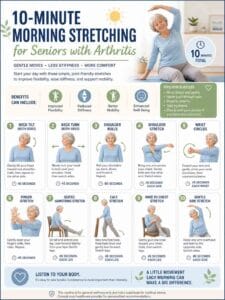
Complete Routine at a Glance
| # | Stretch | Time | Position |
|---|---|---|---|
| 1 | Deep Belly Breathing | 1 min | Lying |
| 2 | Knee-to-Chest Stretch | 1.5 min | Lying |
| 3 | Ankle Circles & Foot Flexes | 1 min | Lying/Seated |
| 4 | Seated Neck Side Stretch | 1 min | Seated |
| 5 | Shoulder Rolls & Cross-Body Stretch | 1 min | Seated |
| 6 | Wrist & Hand Stretch | 1 min | Seated |
| 7 | Seated Hip Opener | 1 min | Seated |
| 8 | Standing Quad Stretch | 1 min | Standing |
| 9 | Standing Calf Stretch | 1 min | Standing |
| 10 | Gentle Back Extension | 0.5 min | Standing |
| Total | ~10 Minutes |
How Often Should Seniors With Arthritis Stretch?
For best results, aim to do this morning routine every day — or at least 5 days a week. Consistency is far more important than intensity when it comes to arthritis management.
Here’s a simple weekly framework:
- Monday–Friday: Full 10-minute morning routine
- Saturday: Light routine (stretches 1–6 only)
- Sunday: Rest, gentle walk, or warm bath for joint recovery
Over time, you can gradually extend holds, add gentle resistance exercises, or incorporate evening stretching as well.
Additional Tips to Manage Arthritis Morning Stiffness
Beyond stretching, these evidence-backed strategies can make your mornings significantly easier:
1. Sleep position matters. Sleeping with a pillow between your knees (for hip and knee arthritis) or a supportive pillow under your neck (for cervical arthritis) can reduce overnight joint compression.
2. Use heat before stretching. A warm shower, heating pad, or warm moist towel applied to stiff joints for 5–10 minutes before your routine dramatically improves stretch quality and reduces pain.
3. Stay hydrated. Synovial fluid is largely water-based. Drinking a glass of water first thing in the morning helps lubricate your joints from the inside out.
4. Anti-inflammatory diet. Foods rich in omega-3 fatty acids (salmon, walnuts, flaxseed), turmeric, ginger, and leafy greens have been shown in multiple studies to reduce systemic inflammation associated with arthritis.
5. Consider aquatic exercise. Water exercise programs for seniors with arthritis are highly effective — the buoyancy of water removes up to 90% of body weight from joints, moving nearly pain-free.
Frequently Asked Questions
Q: Can I do these stretches if I have severe arthritis? Yes, but always consult your physician first. On very painful or inflamed days, skip the routine and apply heat therapy instead. Never push through sharp pain.
Q: How long before I notice improvement? Most seniors report reduced morning stiffness within 2–3 weeks of consistent daily stretching. Full flexibility improvements may take 6–8 weeks.
Q: Should I stretch before or after breakfast? Either works, but many people find stretching before eating — when the body is freshest — helps them be more consistent. A small glass of water before stretching is recommended.
Q: Are these stretches safe after knee or hip replacement? Some may be, but always get clearance from your orthopedic surgeon before resuming any stretching routine after joint replacement surgery. Your physical therapist will also provide a customized protocol.
Q: Is yoga good for seniors with arthritis? Yes — chair yoga and gentle yoga specifically designed for arthritis are excellent complements to this routine. Look for classes specifically labeled “arthritis-friendly” or “senior yoga.”
Living with arthritis doesn’t mean accepting pain as a permanent fixture of your morning. These 10 simple stretches — done consistently and gently — can genuinely transform how you start each day.
Start tomorrow morning. Your body is ready.
Always consult with your healthcare provider before beginning a new exercise or stretching routine, especially if you have a medical condition such as arthritis, osteoporosis, or have had recent surgery.